



Thymoquinone: The active compound that determines the quality of black seed oil
Content
Key takeaways
- Thymoquinone (TQ) is the most extensively studied bioactive compound in Nigella sativa and the key quality marker for black seed oil.
- The range available on the market extends from less than 0.5% to 3.7% – the strongest oil can contain seven to ten times as much active compound as the weakest, often at a similar price.
- The origin of the seeds, cold pressing, filtration, freshness, and storage all determine how much TQ actually ends up in the bottle.
- Only an independent, batch-specific laboratory analysis makes the value verifiable – without a lab report, there is no proof.
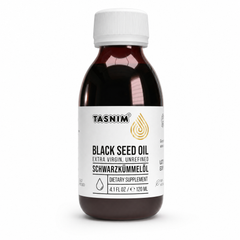
Mentioned in the article
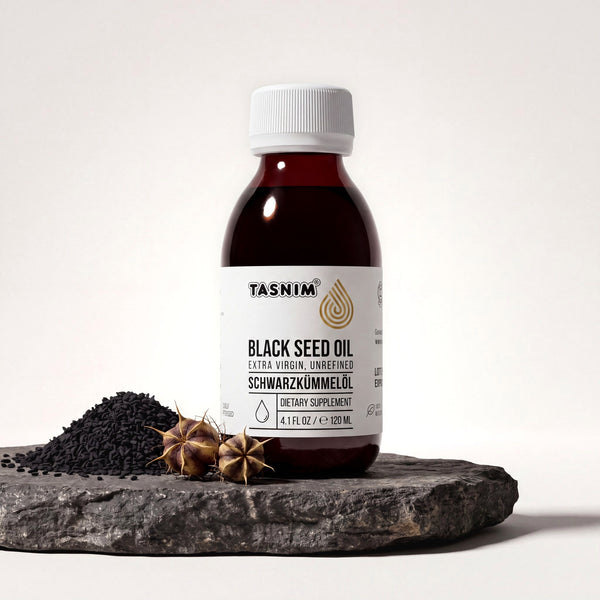
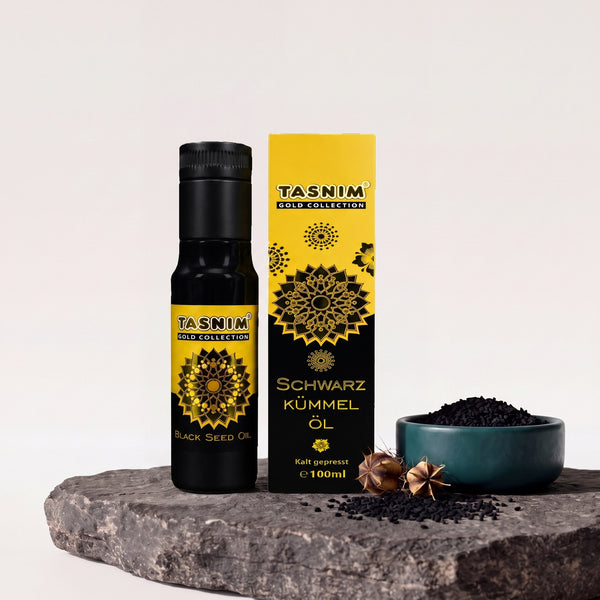
Ethiopian Black Seed Oil – Cold-Pressed & Unfiltered
Cold-pressed · 3.7% thymoquinone · Own mill since 2009
Tasnim Editorial · 2026 · 7 min read
If you place two bottles of black seed oil side by side, they look almost identical. The real difference is in the laboratory report: the thymoquinone content. Thymoquinone – or TQ for short – is the best-researched bioactive ingredient in Nigella sativa and is considered the key quality marker for black seed oil. In this guide, we explain what thymoquinone is, what values are realistic, and why a high TQ content requires special protection.
What is thymoquinone?
Thymoquinone is a secondary plant compound from the quinone group and the main component of the essential oil in black cumin seeds. The plant produces it as a natural protective substance – among other things against intense sunlight. For research, TQ is the most interesting component of Nigella sativa: A large part of the scientific studies on black cumin focuses on exactly this substance.
Why the TQ content is the most important quality marker
The thymoquinone content shows you at a glance how active-ingredient-rich an oil actually is. The range on the market is enormous:
| Oil type | Typical thymoquinone content |
|---|---|
| Basic commercial product (often refined or diluted) | under 0.5% |
| Egyptian black seed oil, cold-pressed | approx. 0.5–1% |
| Ethiopian black seed oil, cold-pressed | 2–3% |
| Tasnim Premium (Ethiopian, unfiltered) | 3.7% – laboratory-confirmed |
Between the weakest and the strongest oil, there is therefore quickly seven to ten times the active ingredient – at a similar price per bottle. That is why it is worth looking at the analysis more than looking at the label.
What the thymoquinone content depends on
- Origin of the seeds: Ethiopian highland black cumin naturally produces the most TQ due to its altitude, sun, and volcanic soils.
- Pressing process: Only gentle cold pressing preserves the heat-sensitive ingredients. Industrial hot pressing or refining destroys a large part of them.
- Filtration: Unfiltered oil retains the fine suspended particles of the seed – and thus a higher concentration of active ingredients.
- Freshness and storage: TQ is sensitive to light, heat, and oxygen. An oil that has been on the shelf for a long time loses measurable content.
Why a high TQ content needs protection
The higher the thymoquinone content, the more important the handling of the oil becomes. The logic is simple:
- Thymoquinone is sensitive to light, heat, and oxygen.
- Oxidation breaks down the active ingredient and changes the taste.
- Therefore, high-quality oils belong in light-protected containers, stored cool, and consumed quickly.
A reputable manufacturer therefore does not press in advance, but in small, fresh batches – and verifies the TQ content for each batch individually.
Laboratory-tested instead of promised: This is how we do it at Tasnim
Since 2009, we have had every batch of our black seed oil independently analyzed – batch-pure and publicly accessible. The current pressing of our Ethiopian premium oil reaches 3.7% thymoquinone, the highest documented value in the DACH market. You can find all analyses transparently on our Thymoquinone analysis page as well as under Certificates.
Conclusion: Do not buy black seed oil without TQ proof
Thymoquinone is the standard by which every black seed oil must be measured. Origin, cold pressing, filtration, and freshness determine the content – and only an independent laboratory analysis makes it visible. Those who pay attention to documented values get many times the active ingredient for their money.
3.7% thymoquinone – black and white
Every batch laboratory-tested. All analyses publicly accessible.
FAQ: Frequently asked questions about thymoquinone
What thymoquinone content is good?
Everything over 1% is already above average. Values of 2–3% are only achieved by Ethiopian highland seeds in combination with gentle cold pressing. The decisive factor is that the value is proven by laboratory analysis for the specific batch.
Does oil with a lot of thymoquinone taste different?
Yes. A high TQ content makes the oil stronger, more aromatic, and slightly spicy. A very mild oil is usually also an oil low in active ingredients.
Can the TQ content drop over time?
Yes. Light, heat, and oxygen break down thymoquinone. Therefore: store dark and cool, close the bottle tightly, and consume quickly after opening.
Is more thymoquinone automatically better for me?
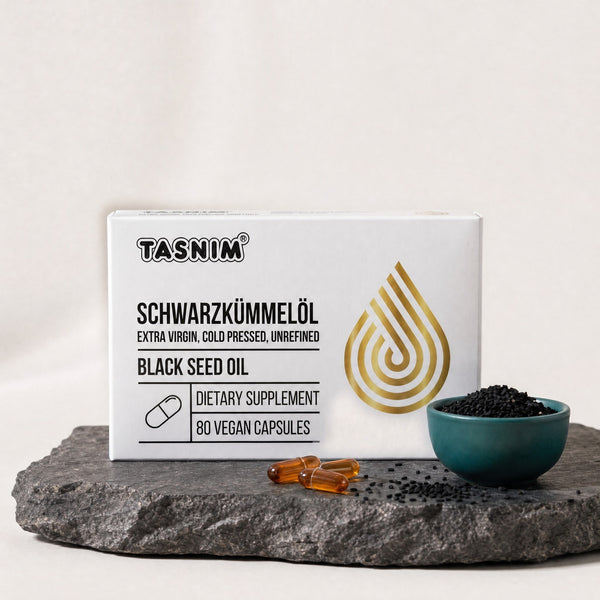
A higher content means a more intense oil. Most people start with small amounts and increase slowly. Those who are sensitive should start with a mild oil or capsules.
Studies & further sources
- Review on Clinical Trials of Black Seed (Nigella sativa) and Its Active Constituent, Thymoquinone – PMC/NCBI
- Aqueous Solubility and Degradation Kinetics of the Phytochemical Thymoquinone – PMC/NCBI
- Black Cumin (Nigella sativa L.): A Comprehensive Review – PMC/NCBI
Note: This post is for general information and does not replace medical advice. Dietary supplements are not a substitute for a balanced diet.
Premium-quality black seed oil
Cold-pressed in our own mill · unfiltered · 3.7% thymoquinone lab-certified
Discover now